
Listen up, folks. There is a time and a place for the slow, meditative ritual of charcoal. I love tending a live fire with a cold beer in hand on a lazy Sunday as much as anyone.
But let’s be real. It’s Tuesday. You just got off work. The kids are hungry, daylight is burning, and you want a perfect ribeye on a plate in 20 minutes flat.
That is why you buy a gas grill.
A gas grill isn’t just an appliance; it’s the reliable workhorse of your outdoor kitchen. It’s the difference between thinking about grilling and actually grilling. But the market is flooded with flimsy metal boxes that won’t last three seasons.
If you want a machine that heats evenly, sears aggressively, and lights up every single time you push that ignition button, you need to know what you’re looking for. I’ve cooked on everything from rusty campground grates to four-figure stainless steel beasts. Here is the no-nonsense guide to choosing the gas grill that deserves a spot on your patio.
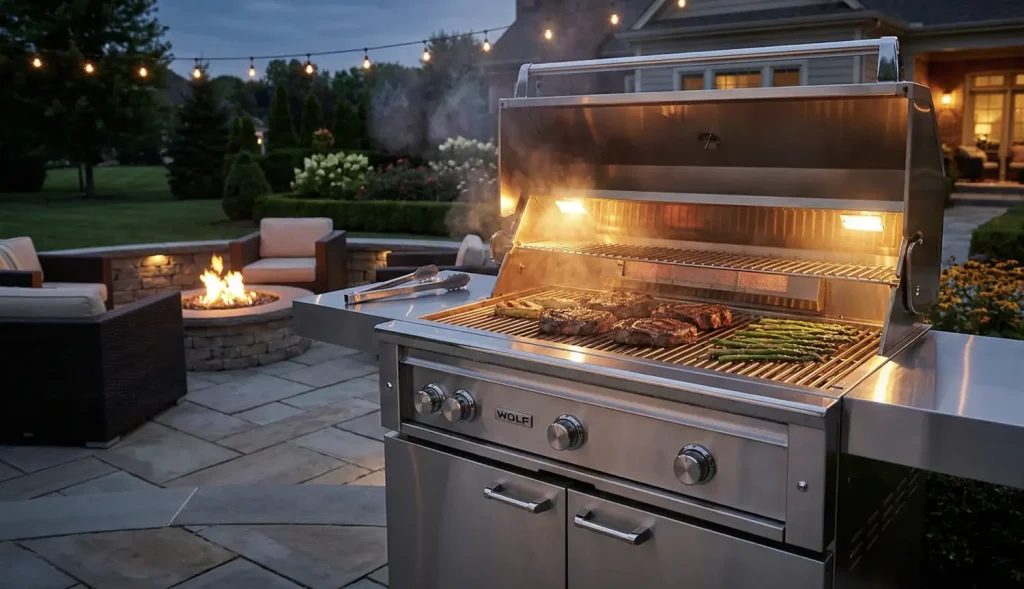
Why Gas Wins the Weeknight War
Look, I’m not here to start a fuel war. I own charcoal grills, pellet smokers, and gas grills. They all have their lane. But the gas grill is the undisputed king of convenience.
If you buy the right one, here is what you are gaining:
- Instant Gratification: Turn knob, push button, fire. You are ready to cook in 10 minutes. No chimneys, no lighter fluid, no waiting for coals to ash over.
- Precision Control: Think of it like your indoor stovetop. Need to drop the heat instantly because your chicken thighs are flaring up? A gas grill responds immediately. Creating “two-zone” fires (one hot side, one cool side) is effortless.
- The Cleanup factor: Shut it down, brush the grates while they’re hot, and walk away. There’s no ash pan to dump the next morning.
A gas grill transforms grilling from an “event” into an everyday cooking method.
The First Big Decision: Propane vs. Natural Gas
Before we look at shiny lids and side burners, you have to make the crucial decision on how you’ll feed the fire. Most grills are sold as one or the other, and converting them later can be a pain or void warranties. But it’s not just about convenience; it’s about long-term costs. Check out our definitive showdown on Propane vs. Natural Gas: Which Fuel is Cheaper and Better? to decide if you want total portability or a never-ending fuel supply.
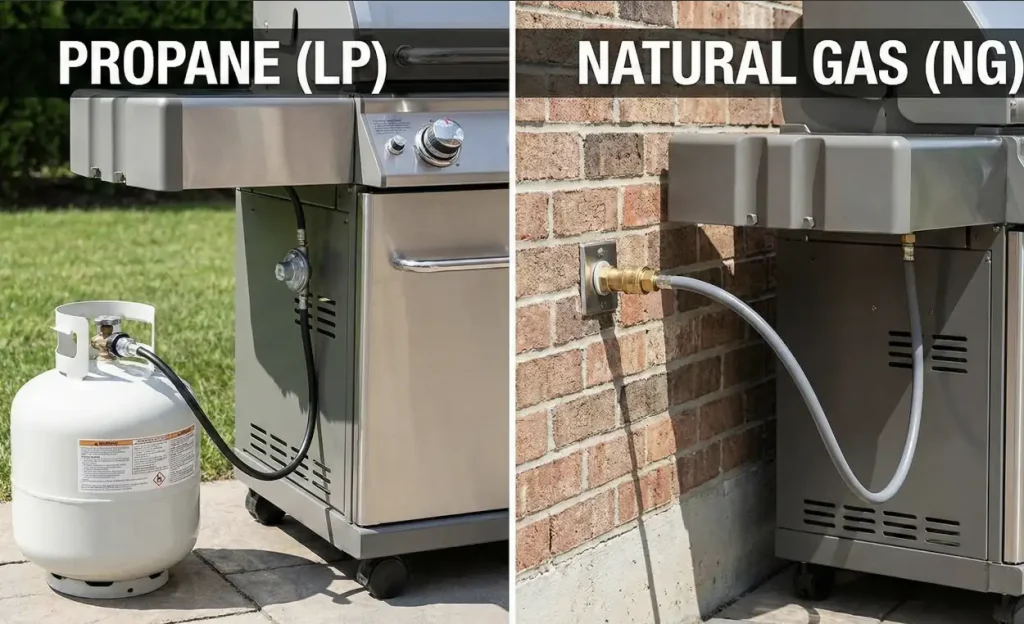
Liquid Propane (LP): The Standard Choice
This is the classic 20lb tank you swap out at the hardware store.
- The Good: It’s portable. You can move the grill around your deck whenever you want. It has a slightly higher energy density than natural gas, meaning it can sometimes burn a little hotter.
- The Bad: The “Mid-Cook Walk of Shame.” Running out of gas halfway through grilling a flank steak is a rite of passage, but it still stinks. You always need a backup tank.
Natural Gas (NG): The “Set It and Forget It” Choice
This connects directly to your home’s gas supply via a hose.
- The Good: You will never, ever run out of fuel. It is significantly cheaper to run in the long term than refilling propane tanks.
- The Bad: You need a gas line plumbed to your patio by a professional. Once it’s hooked up, that grill isn’t moving very far.
The Verdict: If you own your home, have a natural gas line, and know where your grill will live permanently, go NG. Otherwise, stick with the flexibility of propane.
Cutting Through the Smoke: Features That Actually Matter
Walk into a big-box store and you’ll see stickers boasting about massive BTU numbers. Ignore half of that marketing nonsense. Here is what actually makes a grill a “workhorse.”
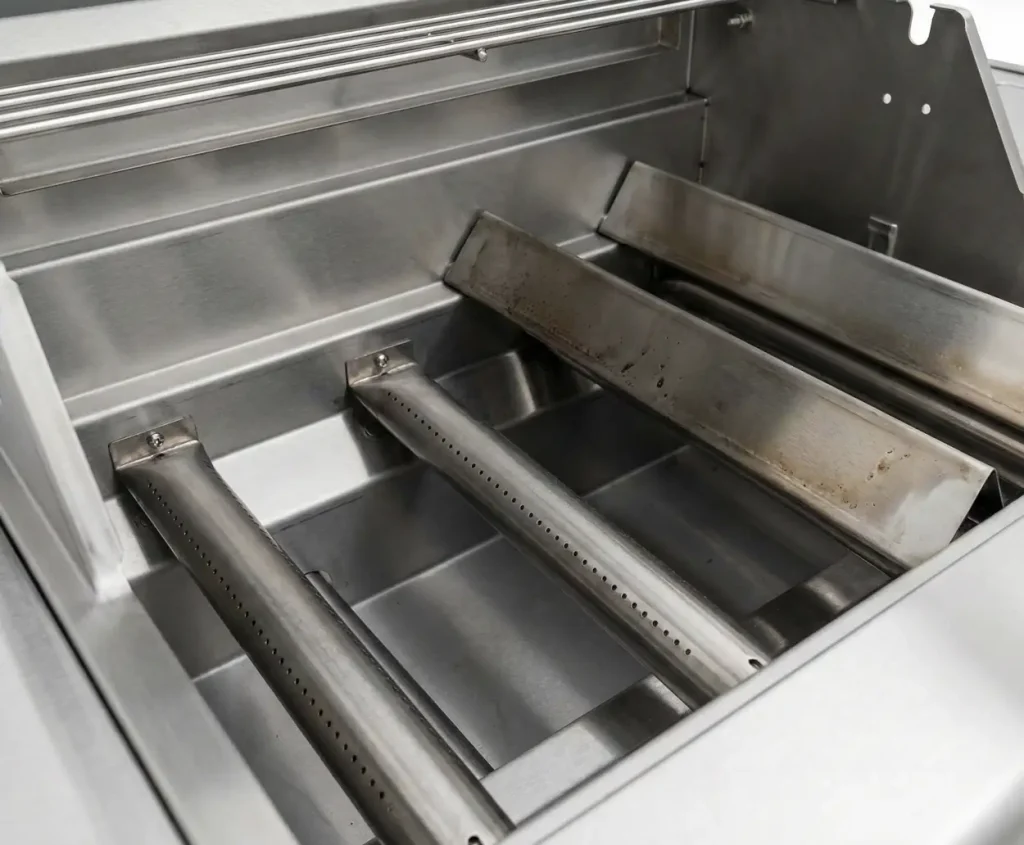
1. The Burners: The Engine Room
Cheap grills use thin, aluminized steel tubes. They rust out in two years, leaving you with hot spots and frustration.
- What you want: High-grade stainless steel tube burners or cast brass burners. Look for warranties of 10+ years just on the burners.
2. The Grates: Where the Magic Happens
This is where the heat meets the meat. You generally have two good options:
- Cast Iron (usually porcelain-enameled): The heavyweight champion. They hold heat incredibly well for those legendary steakhouse sear marks. They require a bit more care to prevent rusting if the enamel chips.
- Heavy-Gauge Stainless Steel rods: The low-maintenance hero. They are incredibly durable, easy to clean, and won’t rust. They don’t sear quite as hard as cast iron, but they last forever.
3. The “Wobble Test” (Build Quality)
Walk up to a display model. Grab the lid handle. Open it. Give the whole grill a shake.
Does it feel like a tank, or does it feel like a folding card table? A workhorse grill has a heavy lid that traps heat, welded joints, and a sturdy cart. If it rattles in the store, it’ll fall apart on your deck.
Finding Your Workhorse: Where Do You Fit?
Okay, you know the basics. Now, where do you spend your money? There is no single “best grill,” only the best grill for your budget and needs.
Below are the different categories of grillers. Click the link that sounds most like you to see my specific top picks in that arena.
The “Value Warrior” (Entry Level)
Target: Under $500. You want something that actually works without paying for a brand name you don’t need.
The Top Pick: Monument Grills Denali 4-Burner (or 41847NG)
This brand has been disrupting the market lately. For under $500, you get features that usually cost double: a glass viewing window (so you don’t lose heat checking the food), LED-lit knobs, and a scorching side burner. It’s not built like a tank, but it cooks like one.
- Best For: The griller who wants maximum features for minimum cash.
The Reliable Classic: Weber Spirit II E-210
It only has two burners, but don’t let that fool you. This grill is a masterclass in efficiency. It gets hotter and stays hotter than cheap 4-burner models. The cast-iron grates are heavy, the grease management system prevents flare-ups, and it will likely last you 10 years.
- Best For: Small families who value longevity over flashiness.
The Budget Beast: Char-Broil Performance Series 4-Burner
If you have $300 and a lot of hungry mouths to feed, this is your play. It’s basic, but it offers a massive cooking area and decent stainless steel styling. It won’t last forever (buy a cover!), but it will get the job done for the next few seasons.
Best For: First-time homeowners on a tight budget.
| Model | Approx. Price | Primary Cooking Area | Total BTUs | Key “Win” | Warranty |
| Monument Grills Denali 4-Burner | ~$599 | 510 sq. in. | 60,000 | Features: Glass viewing window & LED knobs usually found on luxury grills. | 8 Years |
| Weber Spirit II E-210 | ~$449 | 360 sq. in. | 26,500 | Longevity: It’s a tank. Will outlast the others by years. | 10 Years (All Parts) |
| Char-Broil Performance Series | ~$300 | 435 sq. in. | 42,000 | Price: The most affordable way to feed a large family. | 5 Years (Burners) |
The “Backyard Enthusiast” (Mid-Range)
Target: $800 – $1,500. The “sweet spot” of grilling. Better materials, longer warranties, and serious searing power.
The Gold Standard: Weber Genesis E-325s
This is the grill by which all others are measured. The new Genesis line features a massive “Sear Zone” (an extra burner just for high heat) and an expandable top cooking grate. It’s built like a brick house and has the most even heat distribution in the game.
- Best For: The daily griller who wants a machine they can trust implicitly.
The Feature King: Napoleon Rogue SE 425
If you love steak, this is the one. Napoleon is famous for its “Sizzle Zone”—an infrared side burner that hits 1,500°F (800°C) in seconds. It allows you to sear a steak perfectly on the side while slow-roasting veggies in the main chamber. Plus, it usually comes with a 15-year bumper-to-bumper warranty.
- Best For: Steak lovers who want commercial-grade searing at home.
The Heat Hoarder: Broil King Regal S490 Pro
Broil King grills are made in North America and are obsessed with heat retention. The cook box is deep, and the grates are incredibly heavy stainless steel rods. It typically comes with a rotisserie kit included in the box, which is a huge value add.
Best For: The chef who loves rotisserie chicken and high-heat roasting.
| Model | Approx. Price | Primary Cooking Area | Total BTUs | Key “Win” | Warranty |
| Weber Genesis E-325s | ~$999 | 513 sq. in. | 39,000 (+13k Sear) | Reliability: The “Sear Zone” is massive and the heat is perfectly even. | 12 Years (Box) / 10 (Burners) |
| Napoleon Rogue SE 425 | ~$1,199 | 425 sq. in. | 70,500 | Versatility: The infrared side burner (1500°F) is a steakhouse quality game-changer. | 15 Years (Bumper to Bumper) |
| Broil King Regal S490 Pro | ~$1,499 | 500 sq. in. | 50,000 | Heat Retention: Heavy 9mm stainless rods & rotisserie kit included. | Lifetime (Box) / 15 (Burners) |
The “Patio King” (Premium & Luxury)
Target: $2,000+. You want the best. Stainless steel construction, lights, rotisseries, and neighbor envy.
The Luxury Value Leader: Napoleon Prestige PRO 500
This grill looks like it costs $5,000, but it’s usually half that. You get interior lights for night grilling, knob lights that change color if the gas is left on (safety feature!), a rear infrared burner for rotisserie, and that legendary Sizzle Zone. It is a showstopper.
- Best For: The host who wants to impress guests day and night.
The American Muscle: Weber Summit FS38
Weber’s top-of-the-line beast. It features a top-down infrared broiler (like a high-end steakhouse salamander) that caramelizes meat from above. It also has a massive rotisserie system and heavy-duty smoke box integration. It’s big, bold, and American-engineered.
- Best For: The gadget lover who wants the latest grilling tech.
The “Pro” Upgrade: Lynx Professional (Built-In or Cart)
If money is no object, you step up to Lynx. We are talking cast brass burners (which never rust and hold heat like crazy) and seamless welded construction. The “Trident” infrared burner is widely considered the best in the industry. This is a heritage piece you leave to your kids.
Best For: The outdoor kitchen builder who demands perfection.
| Model | Approx. Price | Primary Cooking Area | Total BTUs | Key “Win” | Warranty |
| Napoleon Prestige PRO 500 | ~$2,199 | 500 sq. in. | 80,000 | The “Wow” Factor: Proximity lighting, ice bucket, and commercial build quality. | Lifetime (Limited) |
| Weber Summit FS38 | ~$4,599 | 681 sq. in. | 65,000 | Tech: Top-down infrared broiler (Salamander style) for perfect crusts. | 15 Years |
| Lynx Professional 30″ | ~$5,000+ | 600 sq. in. | 46,000 | Heirloom Quality: Cast brass burners and seamless welded construction. | Lifetime |
The “Space-Saver” (Small Footprint)
Target: Small patios, balconies, and tailgates. Compact size, big flavor.
The Mobile Wonder: Weber Traveler
This is the best portable grill I have ever used, period. It folds down flat like an ironing board but pops up into a full-height grill with one hand. It has a surprising amount of grill space and gets hot enough to sear a ribeye. It sips propane, too.
- Best For: Campers, tailgaters, and people with zero storage space.
The Balcony Boss: Napoleon TravelQ PRO285
Unlike most portables which have one burner, this has two. That means you can actually do indirect cooking (roasting a chicken on one side, burner off) on a portable grill. The high-top lid allows for big roasts, and the scissor cart is rock solid.
- Best For: Apartment dwellers who refuse to compromise on cooking options.
The Little Tank: Weber Q1200 / Q2200
These have been around forever for a reason. The cast aluminum body is virtually indestructible (it won’t rust), and the porcelain-enameled cast-iron grates hold heat better than most full-size grills. It’s simple, rugged, and cooks perfectly every time.
Best For: The “set it and forget it” balcony griller.
| Model | Approx. Price | Primary Cooking Area | Total BTUs | Key “Win” | Warranty |
| Weber Traveler | ~$349 | 320 sq. in. | 13,000 | Portability: Folds flat with one hand; fits in a car trunk easily. | 5 Years |
| Napoleon TravelQ PRO285 | ~$329 | 285 sq. in. | 12,000 | Flexibility: Dual burners allow for indirect cooking (roasting) in a small package. | 10 Years |
| Weber Q1200 | ~$259 | 189 sq. in. | 8,500 | Durability: Cast aluminum body will never rust; perfect for coastal areas. | 5 Years |
The Final Word
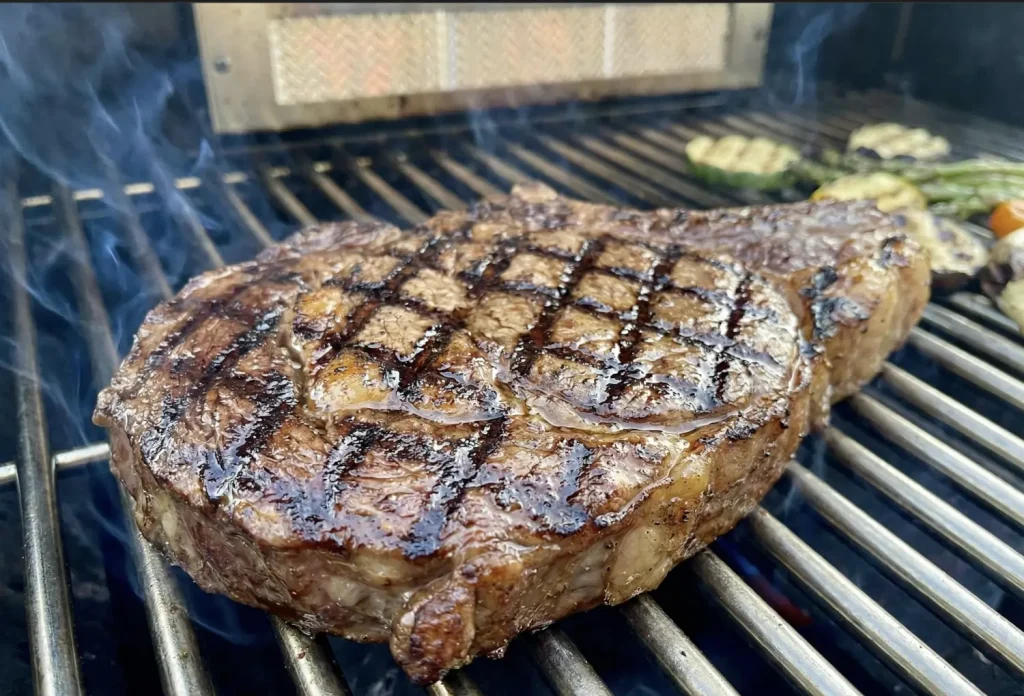
Don’t get paralysis by analysis. The goal here isn’t to buy the most expensive grill; it’s to buy the grill that makes you want to cook outside more often.
Find your budget, pick your fuel, choose a sturdy machine, and get it home. Those steaks aren’t going to sear themselves.