
Look, I’ve been grilling since I was tall enough to reach the knobs. I’ve cooked on everything from rusty tailgating portables to built-in outdoor kitchens that cost more than my first car. And the debate never dies: Propane (LP) or Natural Gas (NG)?
If you’re looking for the short answer: Natural gas is cheaper and more convenient for the daily griller, but propane is the king of portability and upfront simplicity.
But we’re not here for the short answer. We’re here to talk BTUs, heat consistency, and whether you want to be tethered to your house or hauling tanks to the refill station. Let’s break it down.

Heat Output & Performance
Who brings the fire?
There is a massive misconception in the grilling community that propane grills get hotter than natural gas grills.
The Science: It is true that Propane is more energy-dense.
- Propane: ~2,500 BTUs per cubic foot.
- Natural Gas: ~1,000 BTUs per cubic foot.
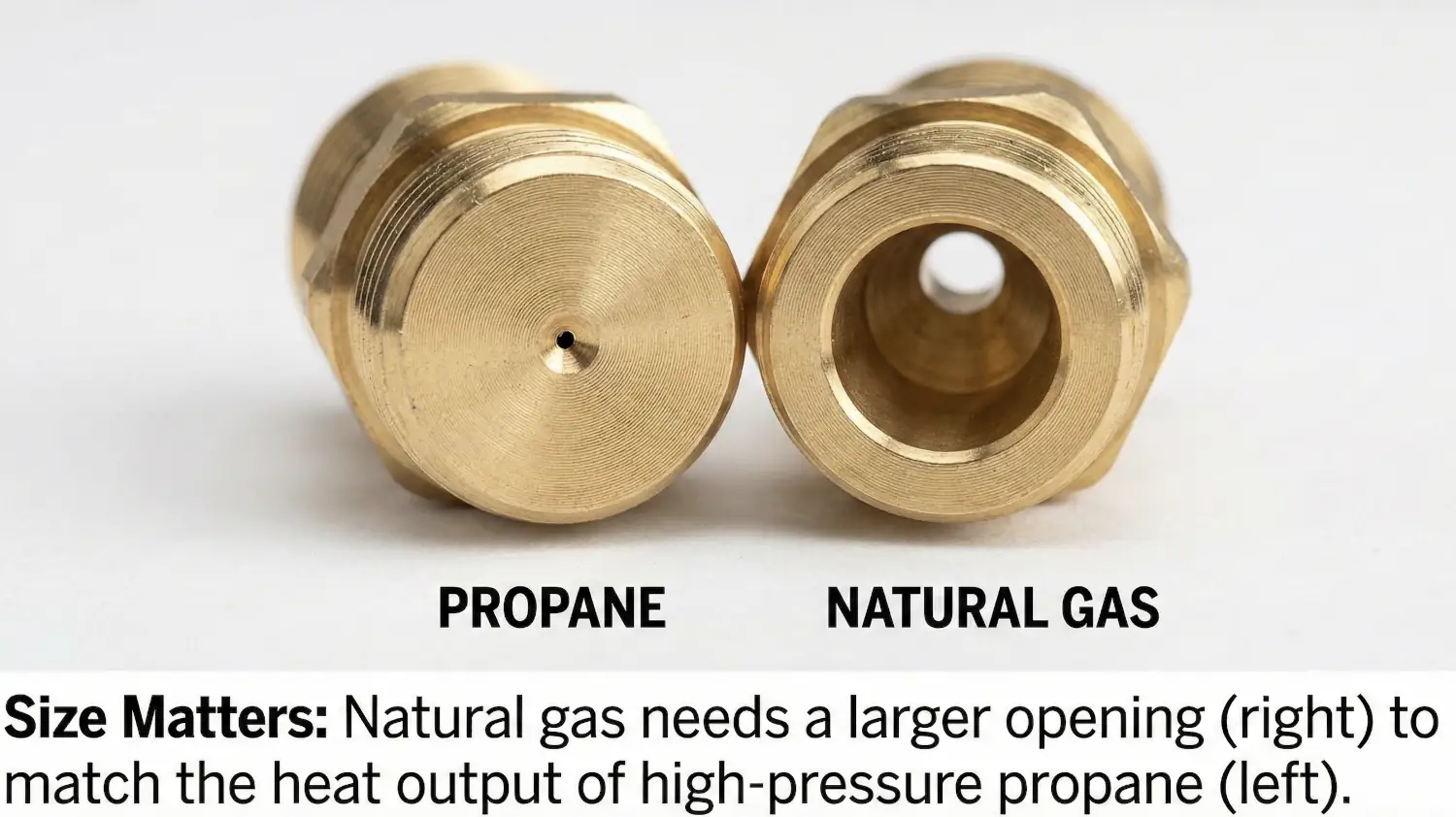
If you pumped the same volume of gas through the same hole, propane would burn twice as hot. However, grill manufacturers aren’t amateurs. Natural gas grills are engineered with larger valves (orifices) to allow more gas to flow through.
The Reality: A 30,000 BTU burner is a 30,000 BTU burner, regardless of the fuel. If your NG grill is properly installed with the right line pressure, it will sear a ribeye just as violently as a propane grill.
Winner: Tie (Provided your grill is properly calibrated).
The Cost Breakdown
Which one hurts the wallet?
This is where the two contenders split significantly.
Upfront Costs:
- Propane: The grill is usually cheaper (or the same price), and all you need is a $50 tank. You are ready to cook in 5 minutes.
- Natural Gas: You need a gas line run to your patio. If you don’t have a stub-out already, hiring a plumber to run a line can cost anywhere from $300 to $1,000+.
Operating Costs (The Long Game):
- Propane: Filling a standard 20lb tank costs $15–$25. That tank holds roughly 430,000 BTUs of energy.
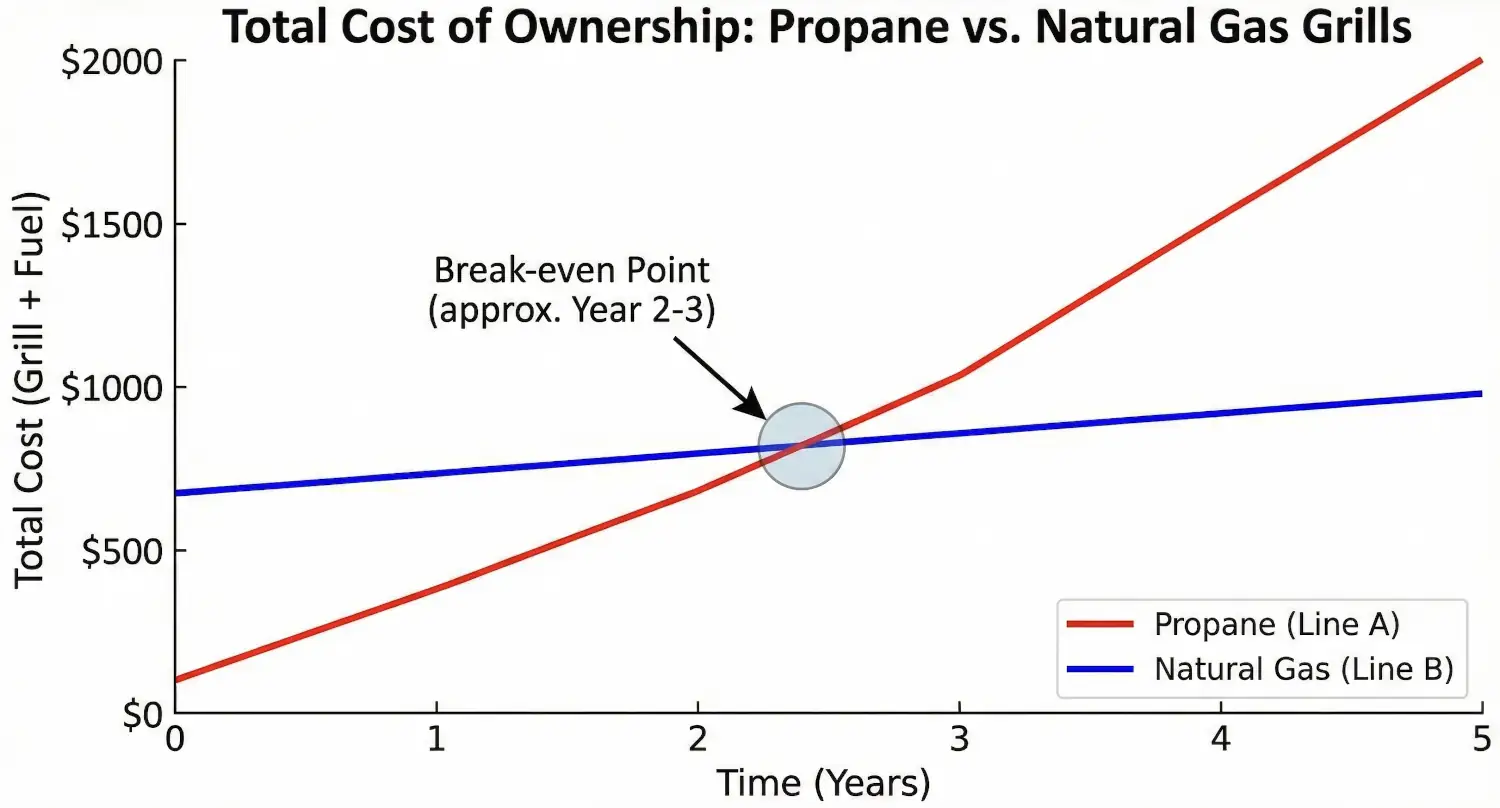
- Natural Gas: Natural gas is delivered by your utility company and is significantly cheaper per BTU. In many areas, natural gas is roughly one-third to one-sixth the price of propane for the same amount of cooking energy.
The Verdict: If you grill once a month, stick with Propane. You’ll never recoup the installation cost of a gas line.
If you grill 3-4 times a week (like I do), Natural Gas pays for itself in fuel savings over a few years.
Winner: Natural Gas (for the frequent griller).
The ‘Hidden’ Entry Fee: Conversion Kit Prices (2026)
You might think a hose is just a hose, but in the grill world, brands matter. Here is what you can expect to pay for a legitimate, safe conversion kit right now:
| Grill Brand | Kit Price (Est.) | The “Grill Guy” Note |
| Weber | $110 – $165 | Strict. Newer Webers (Genesis II, Spirit II) are notoriously picky. Many warranties are voided if you use aftermarket parts. You often have to buy the specific “Natural Gas” version of the grill upfront. |
| Napoleon | $95 – $140 | User Friendly. Napoleon actually wants you to convert. Their kits are easy to find and come with high-quality flexible hoses and quick-disconnects. |
| Blackstone | $45 – $75 | Best Value. Since griddles use low pressure and simple burners, their kits are cheap and almost universally available at hardware stores. |
| Nexgrill / Dyna-Glo | $50 – $90 | Dual-Fuel Ready. Many of these are built with conversion in mind. The kits are simple, but check the threading twice before buying. |
| “Universal” Kits | $35 – $65 | The Gamble. Sold on Amazon under weird brand names. They might fit, or they might leak. Is saving $30 worth singeing your eyebrows? (No). |
Pro Tip: Don’t just look at the price of the kit. If you don’t have a gas pipe sticking out of your wall already, you need a plumber. That will run you another $300 to $1,000 depending on how far your patio is from the meter.
Convenience & “The Dread Factor”
The Walk of Shame vs. The Tether
Every propane griller knows “The Dread.” You have friends over, the burgers are half-done, and the flame dies. You shake the tank. Empty. Now you are doing the “Walk of Shame” to the garage to see if your backup tank is full. If it’s not, you’re driving to the hardware store while your guests eat chips.
Natural Gas:
Pros:
- You have an infinite supply of fuel.
- You never have to lift a heavy tank again.
- You never run out mid-cook.
Cons:
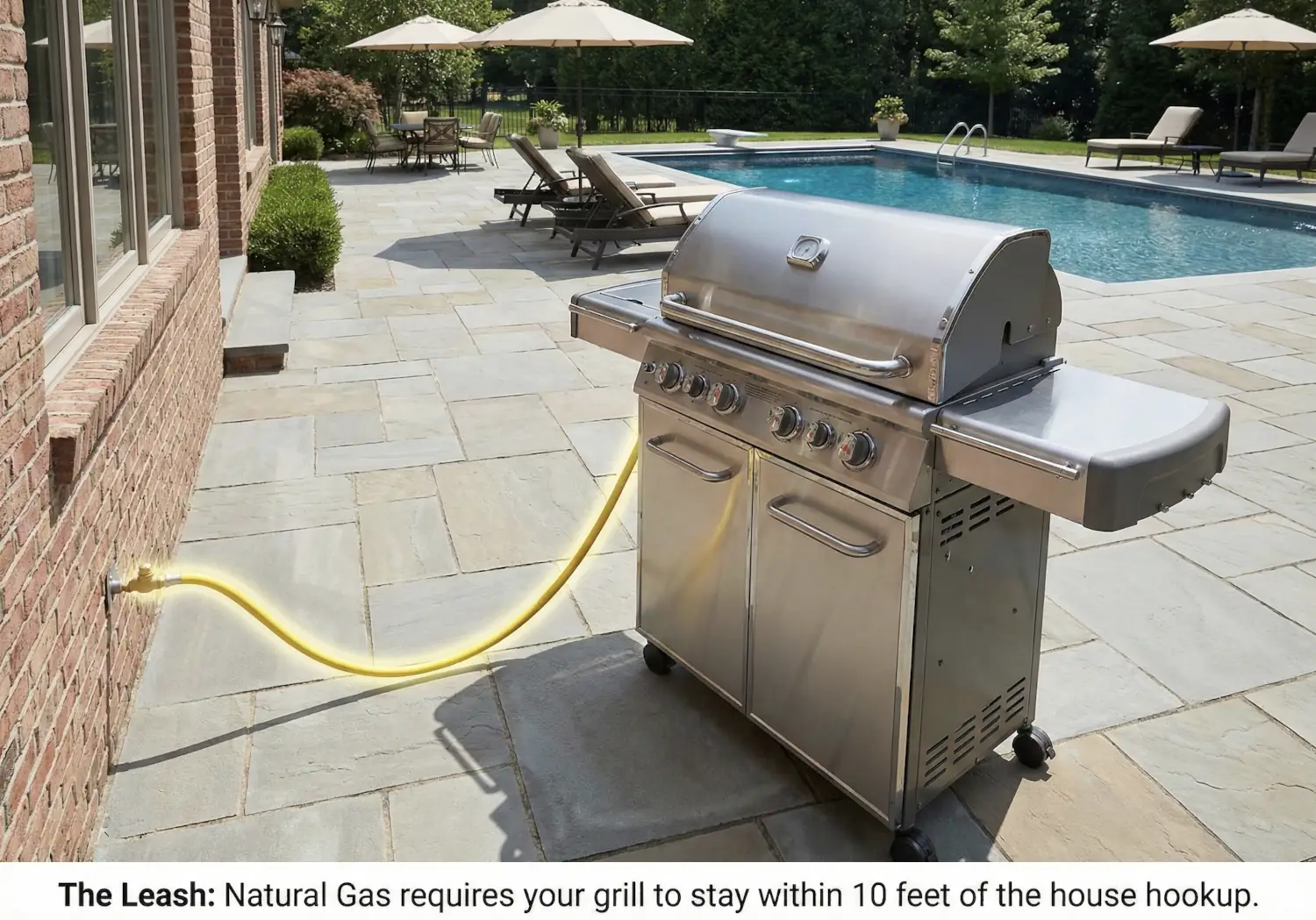
- You are tethered.
- Your grill lives where the gas pipe is.
- You cannot move it to the other side of the deck to get out of the wind.
Propane:
Pros:
- Total freedom.
- Move the grill to the pool, the driveway, or load it in the truck for a tailgate.
Cons:
- Refilling tanks is a chore.
- You must own a backup tank.
Winner: Natural Gas for peace of mind; Propane for flexibility.
Summary: The Tale of the Tape
| Feature | Propane (LP) | Natural Gas (NG) |
| Fuel Cost | High ($$) | Low ($) |
| Setup Cost | Low (Plug & Play) | High (Plumbing required) |
| Portability | High (Move it anywhere) | None (Fixed location) |
| Heat Output | High (Energy dense) | High (High flow rate) |
| Eco-Friendliness | Clean burning | Cleanest burning fossil fuel |
| Best For… | Renters, Tailgaters, Casual Grillers | Homeowners, Daily Grillers, Outdoor Kitchens |
My Final Recommendation
Choose Propane if:
- You rent your home.
- You have a small patio and need to move the grill often.
- You only grill on weekends in the summer.
Choose Natural Gas if:
- You own your home and plan to stay a while.
- You grill year-round (even in the snow).
- You are building an outdoor kitchen (this is non-negotiable—nobody wants to crawl under a granite counter to swap a tank).
Whichever you choose, just keep the grates clean and the lid closed. Now, go light it up.
Here is a high-value FAQ section optimized for those specific long-tail search queries. Paste this at the very end of your article, right before the conclusion.
FAQ: Quick Answers for the Curious Griller
Q: Can I use a natural gas hose on a propane tank (or vice versa)?
A: Hard No. This is dangerous. Propane is stored at a much higher pressure than natural gas. The hoses, regulators, and fittings are completely different. If you try to rig this up with adapters, you risk a massive flare-up or an explosion. Never mix the fuel sources without a proper conversion kit.
Q: Does food taste different on Natural Gas vs. Propane?
A: No. This is a classic BBQ myth. Both propane and natural gas are odorless when they burn cleanly (that “gas smell” is an additive called mercaptan, and it disappears during combustion). If your burger tastes like fuel, your grill isn’t burning efficiently—it has nothing to do with which gas you are using.
Q: Do natural gas grills work in the winter?
A: Actually, they work better than propane in extreme cold. As the temperature drops, the pressure in a liquid propane tank decreases, which can lead to a weak flame on freezing days. Natural gas comes from the utility line at a constant pressure, so your grill will fire up reliably even if it’s 10°F (-12°C) outside.
Q: Can I run the natural gas line to the patio myself?
A: In most cities, no. Gas plumbing almost always requires a licensed professional and a permit. Insurance companies love to deny claims for fires caused by unpermitted DIY gas work. Pay the plumber—it’s cheaper than a new house.
Q: Why is my natural gas flame yellow and weak?
A: You likely have an air-to-fuel mixture problem. Because natural gas is lighter than propane, it needs a different air shutter setting. Check your burner tubes—there is usually a screw that lets you open or close a small window (the shutter). Open it slightly to let more air in until the flame turns blue.